
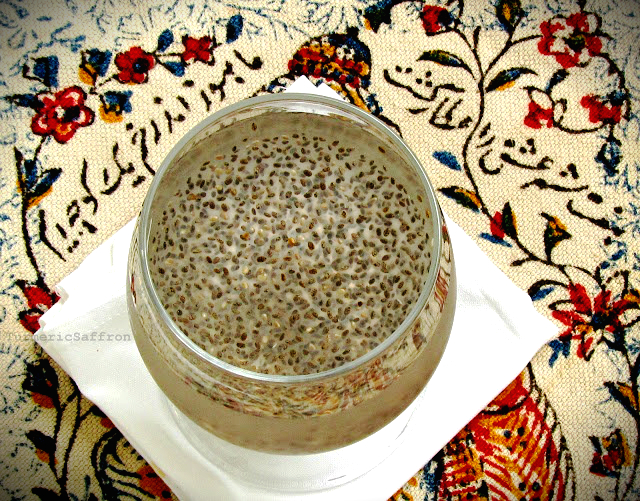
The summer heat and humidity persist, which gives me a good reason to write about this traditional and cooling Iranian-style summertime sharbat (sherbet). I had briefly mentioned tokhme sharbati in my post about khakshir, stating that it may be added to a glass of khakshir drink for a richer drink. However, I feel that شربت تخم شربتی sharbat-e tokhme sharbati needs to have its own post and be recognized as a delicious and nutritional herbal drink with many health benefits. Tokhme sharbati is known to cool down the body, help improve hydration, and is a good source of antioxidants. It's also a beautiful drink to have, with its grayish fuzzy seeds floating in the ice-water glass. It's like looking at the nighttime silver-blue sky covered with the tiniest gleaming stars that seem connected from afar but are actually very far apart.

Finding the English name for tokhme sharbati was quite a challenge. The label on the package that I purchased from an Iranian grocery store said chia seeds. However, after Googling tokhme sharbati, I also came across names such as basil seeds or mountain basil seeds.
شربت Sharbat has a long history in the Persian cuisine with many variations. Ismail Gorgani wrote in his 12th-century Persian book, Zakhireye Khawrazmshahi, which was very much influenced by Ibn Sina's book of Qanoon (Canon of Medicine), about sharbat such as sekanjabin, pomegranate, etc. These sugar-sweetened drinks may be made with fruits, vegetables, herbal seeds, rose water, and saffron. Now that we are told not to eat too much sugar and almost everyone is concerned about not becoming diabetic, I reduced the amount of sugar in this recipe compared to the recipe that was used in our home growing up. You may want to adjust the amount of sugar/sugar syrup to your taste and your diet. You can also substitute honey for sugar. I should point out that the authentic Iranian way of adding sugar to any sharbat is to make a sugar syrup first. For sugar syrup, add a cup of sugar to a cup of water in a small pan, bring to a gentle boil on medium-high heat, stir until sugar is completely dissolved. Lower the heat and simmer for another 15-20 minutes until the syrup is reduced and thickens a bit.

Sharbat-e Tokhme Sharbati
Ingredients:
Serves 2
2-3 teaspoons tokhme sharbati (chia seeds), can be found in Iranian/Persian markets
2 cups cool water
2 tablespoons sugar
1 tablespoon rose water
A few drops of freshly squeezed lime or lemon juice
Method:
- Stir the sugar in 1/2 cup of warm water until fully dissolved or use a couple of tablespoons of the sugar syrup as explained above.
- Combine the seeds, water, and the dissolved sugar, refrigerate for at least 2 hours for the seeds to plump up.
- Add the rose water and a few drops of lime juice to taste. The drink is best served cold.
We used to call it 'tukhm balanga' and add it to drinks made with Rooh Afza or one with milk and falooda (noodle). Indeed they are basil seed of the green or the sacred basil and not the purplish European variety. They taste differently and the fragrance of sacred basil (called tulsi and grown in every Hindu home as it is used as part of devotional service) is much more defined. Javed
ReplyDeletechia seeds are not tukhm balanga or basil seeds. basil seeds are darker and tinier than chia seeds
Deleteoh so refreshing. perfect drink for fasting break. :) Happy Ramadan, Azita
ReplyDeleteLooks so refreshing! Chia pet's ancient cousin.
ReplyDeletethis is such a refreshing drink. your pics are also good.
ReplyDeletein india we call the basil seeds by the name of sabja/sabza. i think chia seeds are different from basil seeds. in the summers i use these seeds often with rose sherbet or rooh afza. we also add these to falooda.
I can't begin to tell you how fortuitously timely this post is for me: I had ordered a whole packet of chia seeds (they're supposed to be good for the liver) and was looking high and low for a palatable way to consume it. I knew about this sharbat but didn't know how to make it (mamanam ham dorost hessabi nehmidonest) and so: I thank you, and my liver thanks you! Also, what a lovely and poetic post!
ReplyDeleteI am so happy to have this blog. Thank you so much. This blog is so inspiring to me. I cannot tell you how much i appreciate it. Thank you so much!
ReplyDeleteSo this a great, healthy drink. I hated it as a kid, but now, I live on chia seeds. i have a jar at my desk and add it to all my oatmeals, and mushy type foods. Chia seeds are actually a lot more common now, so you can buy them at a lot of stores. Whole Food, and most of the chain one carry chia seeds now. Great post.
ReplyDeleteYour photos are absolutely gorgeous! This is such a great idea for a post. I had a drink similar to this in the home of an Indian friend. I have chia seeds in my freezer and I'm going to try this. Thanks for the inspiration! -Louisa
ReplyDeleteNever found such informative articles
ReplyDeleteDear Azita,
ReplyDeleteI am following you from Hungary. I really like your blog, the photos are beautiful, and the recipes exciting and to me very exotic.
In this post I particularly love the poetic metaphor as you describe the sharbat.
Seen from here, I find it “very Persian” .)
The commentators also note that chia and tokhme sharbati are not exactly the same. I also see on the internet that chia is native in South America, while tokhme sharbati in Iran.
In what I have read, the amazing health-protective and healing effects were connected with chia. Could you please say something about the differences and similarities between them? or are they really the same plant?
Thank you, and best wishes,
marguerite
Dear Marguerite, thank you very much for your kind words. From reading about the benefits of both chia seeds and tokhme sharbati (basil seeds) I would say that the benefits are more or less the same. However, I remember the tokhme sharbati that I used to have in Iran as being more gelatinous, and the seeds were a bit smaller, rounder and slightly lighter in color. Thank you again.
DeleteAzita
This is so poetic! We had a torrid summer in Italy as well, I regret to have found this now that it's almost over... but I'll try to find your magis seeds and keep you updated, in the meanwhile I am cutting quinces to make your cardamom and rose water jam. Finding your beautiful blog via a recipe (the quince jam) on Pinterest really made my day, thank you for sharing!
ReplyDeleteThank you and I'm so glad that you found my blog!
Deleteby the way, here's my drop on chia seeds as well. According to internet the botanic name of it is Salvia Hispanica (literally Spanish Sage) which despite the name is not sage but belongs to the mint family. Is it possible that this is the one?
ReplyDeleteHere some photos of the seeds:
http://en.wikipedia.org/wiki/Salvia_hispanica Spanish Sage
http://en.wikipedia.org/wiki/Salvia_columbariae California Sage
Yes, it's possible. Looks the same to me. Thanks.
DeleteI adore your blog Azita! You are so down to details and knowledgable. Plus its so nostalgic. You should have your own book.
ReplyDeleteThank you very much! Perhaps one day I will.
DeleteAzita, I heard so many good things about chia seeds...I have to try this drink...sounds refreshing!
ReplyDeleteLovely, I remind this from my childhood.
ReplyDeleteThank you Azi jaan, this is great!
Mokhless,
Sufi
Thank you Sufi jaan.
DeleteThis drink will forever conjure up a hot day roaming Persepolis near Shiraz, where I first tasted Sharbat Tokhme. It was completely refreshing on that day. I purchased the seeds but was unsure how to duplicate it, so thank you for this post! We will give it a try with my grandchildren this coming summer.
ReplyDeleteOhhh!! I have these seeds! My mother gave them to me, apparently her father found them at a somali store. They're black and it says basil seeds on them but I tried to grow them and they turned white and gelatenous, so this is an interesting use for them. Couldn't really figure out what to do with them.
ReplyDeleteThanks for sharing!!
The poster above was right... basil seeds are NOT the same as Chia seeds. Chia and Salvia hispanica are one and the same. They are rich in B vitamins and omega fatty acid. Basil seeds look similar, and have virtually the same properties, but you can't grow basil from chia seeds! LOL! I put a tablespoon or two right into my iced tea or any other cold drink I might be having... delicious!
ReplyDeleteA good recipe is: 1/2 cup of Almond milk, 1/2 cup of coconut milk, one spoon of chia seeds and a little sugar (optional). Cut 1/2 of cup of mango or fruit of your choice and add it to the mixture. Put the combination in the refrigerator for two hours. You will have a wonderful desert. You can double the recipe for more servings.
ReplyDeletesalam Azita khanum I really adore this post because it reminds me of a childhood favourite; yes, here in Malaysia we also consume tokhme sharbati in almost the same way as Persians do...I remember how my mother would soak a little bowlful of these tiny black seeds which would expand and develop a jelly-like coating in a short time...she would then drain the seeds and add them to a jug full of iced diluted rose-flavoured cordial, which we call "air merah" in the Malay language, literally meaning "red water" because it is actually red in colour...as for tokhme sharbati, we call them "biji selasih"...it's still very popular today where it is featured in almost every variety of Malaysian-style sharbat one can think of...
ReplyDeleteSalam Gaby jan, thank you so much for your sweet and informative comments.:)
DeleteThank You so much for sharing these useful information with the world. Actually I'm drinking Tokhme-Sharbat with hot water and honey. It's so good for sore throat and it relieves cough.
ReplyDeleteThank you for the blog post! I love learning about my persian roots and persian recipes!
ReplyDeletethanks a lot. i had hard time to find what tokma in english.
ReplyDeleteAzita, you are my "google"!!! You haven't failed me in finding those precious recipies of my childhoods as yet!
ReplyDeleteThank you, you are an ace.